November 3, 2026
9-minute read

Verified Reviews for Marketplaces: First-Party vs Third-Party

First-party reviews are reviews a marketplace collects and publishes on its own platform. Third-party reviews live on outside sites like Google, Yelp and Facebook. A review is "verified" when it is tied to a real transaction, such as a completed booking or job, and many marketplaces benefit from both kinds: verified first-party reviews to build trust inside the product, and third-party reviews for reach and outside credibility.

This guide covers both types, what "verified" should mean, two-sided reviews, moderation policy, and the US rules from the FTC and Google. It is general information, not legal advice. Talk to your own counsel before you set policy.

First-party vs third-party reviews

First-party reviews

First-party reviews are collected inside your own product, usually right after a customer finishes a booking, order or job. You own the data, the review form and the display.

  • Pros: you can limit reviews to real customers, ask the questions that matter for your category, show reviews exactly where buyers make decisions, and use the data in search ranking and quality programs.
  • Cons: you are responsible for collection, verification, moderation and disputes. Buyers may trust a review less if they think the platform controls it. Google won't show review stars on a business's own LocalBusiness or Organization pages when it controls the reviews about itself (more on that below).

Third-party reviews

Third-party reviews are written on independent sites such as Google, Yelp, Facebook and industry review sites. Your providers usually already have them.

  • Pros: they come with outside credibility, they already exist in volume, and they show up where people search.
  • Cons: you don't control the format, the rules or which reviews a site filters. Anyone can post, so a review may not come from a real customer. Each site has its own access and display terms.

Why use both

A common setup: collect verified first-party reviews for every completed transaction as the main rating, and show third-party reviews as extra context, labeled with their source. Never present outside reviews as your own verified ones.

What "verified" should mean

"Verified" is only useful if it means something specific. The strongest standard ties each review to a record in your system that proves the reviewer was a real customer of that provider.

  • Transaction-based: only customers with a completed booking, order or job can leave a review, and the review is linked to that record.
  • Evidence-based: reviews from other channels are checked against supporting evidence, such as an invoice, a job record or a booking confirmation.
  • Time-bound: the review window opens after the service is done and closes after a set period, so reviews reflect a recent experience.

Write your standard down and publish it. A short "What verified means" note next to the label tells readers what was checked.

Two-sided reviews

Many marketplaces let both sides review each other: customers review providers, and providers review customers. This helps both sides behave well, but it adds risks you should design for.

  • Retaliation: if one side can read the other's review first, it may respond with a revenge rating. A common fix is to hold both reviews until both sides submit or the review window closes, then publish them together.
  • Pressure: providers may push customers for a high rating in person. Make it easy to report this, and tell customers their review goes straight to the platform.
  • Visibility: decide who sees what. Provider reviews of customers are often shown only to other providers.

Writing a moderation policy

The FTC's 2022 guide for businesses that host reviews, Featuring Online Customer Reviews, is a good starting point. It tells platforms to treat positive and negative reviews equally, to publish all genuine reviews and not exclude negative ones, and not to edit reviews to alter the message.

What you can remove

Set content rules and apply them the same way to every review, whatever the rating. The FTC rule itself lists criteria like these that don't count as suppression, as long as you apply them to every review whatever its sentiment:

  • Reviews you reasonably believe are fake, or reviews that don't meet a verification standard you apply to every review.
  • Defamatory, harassing, abusive, obscene, vulgar or sexually explicit content, or content that is discriminatory.
  • Another person's personal information or likeness, such as a phone number or home address.
  • Trade secrets or confidential business information.
  • Content that is clearly false or misleading, or wholly unrelated to the provider's products or services.

What you should never remove

  • A genuine negative review, just because it is negative.
  • Low ratings with legitimate criticism, even if the provider disagrees.
  • Reviews a provider asks you to take down without a policy reason.

Also avoid quieter forms of suppression. The FTC's Endorsement Guides FAQ warns that delaying only negative reviews, even by a few days, could create a biased picture. Hold all reviews for the same period, or none.

Disclosure

The FTC's 2022 platforms guide says to explain how you collect, process and display reviews, and how overall ratings are worked out, to the extent needed to avoid misleading people. In practice, publish a short page on who can review, what "verified" means, what you remove and how disputes work.

Handling incentives

The FTC rule does not ban all incentives, but it does ban incentives that depend on the review being positive or negative. If you allow incentives at all, offer them for any honest review, label incentivized reviews, and watch whether they shift the average rating. Some platforms don't allow them at all. Our post on whether you can pay for positive reviews goes deeper. If your platform also sends review requests by email or SMS, see review solicitation compliance for platforms for the messaging rules.

The FTC rule on consumer reviews and testimonials

The FTC announced its final rule banning fake reviews and testimonials on August 14, 2024. It is the Trade Regulation Rule on the Use of Consumer Reviews and Testimonials, 16 CFR Part 465. The FTC's Questions and Answers page says it went into effect on October 21, 2024, and that it lets courts impose civil penalties for knowing violations.

According to the FTC's announcement, the rule covers:

  • Fake or false reviews: creating or selling reviews that misrepresent who wrote them or that the writer had real experience with the business, including AI-generated fake reviews, and buying or spreading them when you knew or should have known they were fake.
  • Buying positive or negative reviews: offering compensation or incentives conditioned on a review expressing a particular sentiment.
  • Insider reviews: reviews by officers or managers, and reviews they ask employees, agents or immediate relatives to write, that don't clearly and conspicuously disclose the connection to the business.
  • Company-controlled review websites: claiming a site you control gives independent reviews of a category that includes your own products.
  • Review suppression: using baseless legal threats, physical threats, intimidation or certain false accusations to remove negative reviews, and claiming the reviews you show represent all or most reviews when negative ones were suppressed.
  • Fake social media indicators: buying or selling fake followers or views to misrepresent influence.

Three points from the Q&A matter for marketplaces. First, the fake-review section has an exception for businesses that only host reviews, and it still applies if you ask customers for reviews or show average star ratings. The exception is narrow: the rules on buying reviews and on review suppression still apply to sites that collect and display reviews. Second, a content rule (for example, not posting reviews about other products) is fine as long as it treats positive and negative reviews equally. Third, reviews you pull into your own marketing, such as ads or landing pages, are treated as testimonials and fall outside the hosting exception.

The FTC Endorsement Guides

The Endorsement Guides (16 CFR Part 255) are separate from the rule. They explain how the FTC Act applies to endorsements, including consumer reviews. The FTC's FAQ page says they were revised in 2023. For a marketplace, the main points are:

  • Asking for reviews only from customers you expect to be happy would be misleading if it substantially skews the reviews. The safe default is to ask every eligible customer.
  • If reviewers got something of value, such as a free product, that connection should be disclosed. If those reviews push the average up noticeably, the FAQ says to disclose it next to every overall or summary rating that includes them.
  • Asking unhappy customers to change or delete a negative review could mislead readers.

Structured data and Google's self-serving reviews rule

Review structured data (schema.org Review and AggregateRating) can make a page eligible for star ratings in Google results. Google's review snippet documentation sets limits that affect marketplaces:

  • Self-serving reviews: if the entity being reviewed controls the reviews about itself, its pages that use LocalBusiness or other Organization markup are not eligible for star review features.
  • No aggregation: Google says not to aggregate reviews or ratings from other websites. Don't mark up Google or Yelp reviews you display on your pages.
  • Visible content: the reviews you mark up must be readily available to users on that page.

Reviews of independent providers on a marketplace are a different case, but eligibility is Google's call.

For platforms: running verified reviews by API

Shout About Us is the review management API for marketplaces and platforms. The Verified Reviews API is built for the first-party side described above. According to the product page, it lets you:

  • Collect reviews inside your own product, so the interface and the customer relationship stay with you.
  • Verify each review with a human verification team that checks it against criteria agreed with your platform, such as booking or job records or other evidence you supply. Reviews that don't meet the standard are escalated instead of published.
  • Moderate with a managed team that applies your content policy. Legitimate criticism, including low ratings, is published. Content that breaks the rules is held, and edge cases are escalated to you.
  • Publish approved reviews with a verified label backed by the evidence standard you define.

Verified Reviews is not generally available yet. Our developer docs list it as coming soon for approved partners. Book a demo to ask about access.

For the third-party side, the Review Data API pulls reviews from Google, Yelp, Facebook and 80+ sites into one format, so you can show them as labeled outside context. Review Insights adds AI reports on what reviews say, the Review Solicitation API sends email and SMS review requests, the Review Response API drafts and posts replies, and the Review Removal API submits removal requests for reviews that break a site's own rules. Pricing is $0.50 to $3.00 per location per month plus usage for the APIs you use.

FAQ

What is a verified review?

A verified review is one tied to proof that the reviewer was a real customer, such as a completed booking, order or job in the platform's records. The platform should publish what it checks, so readers know what the label means.

Can a marketplace remove negative reviews?

Not just for being negative. You can remove reviews that break a content policy you apply equally to all reviews, such as harassment or personal information. Hiding genuine negative reviews can mislead buyers, and the FTC rule bars claiming the reviews you show represent all or most reviews when negative ones were suppressed.

Do I have to check every review for fakes under the FTC rule?

The FTC's Q&A says the rule has no requirement for hosts to investigate whether hosted reviews are fake. The FTC's separate platforms guide still recommends reasonable processes to confirm reviews are genuine. A verification standard does both jobs.

Build a review program buyers trust

If you are planning verified reviews for a marketplace or platform, see how the Verified Reviews API handles collection, verification and moderation, then book a demo to talk through your verification standard and content policy.

Emily Homrok

Emily Homrok is a freelance copywriter with more than seven years of writing experience. She joined the Shout About Us team as a content strategist in 2020.

SHARE THIS ARTICLE:

Frequently asked questions

No items found.
All
Best Practices
Review Data API explainer: what a review API is and how platforms use it
November 2, 2026
8-minute read
What Is a Review API, and How Do Platforms Use It?

A plain-English guide to review APIs: the main types, how platforms use them, and a checklist for choosing one.

Emily Homrok
All
Best Practices
How much does a review management API cost? Pricing guide from Shout About Us
October 13, 2026
7-minute read
How Much Does a Review Management API Cost?

Pricing models, cost drivers and build-vs-buy for platforms, plus Shout About Us pricing: $0.50 to $3.00 per location per month plus usage.

Emily Homrok
All
Best Practices
October 5, 2026
5-minute read
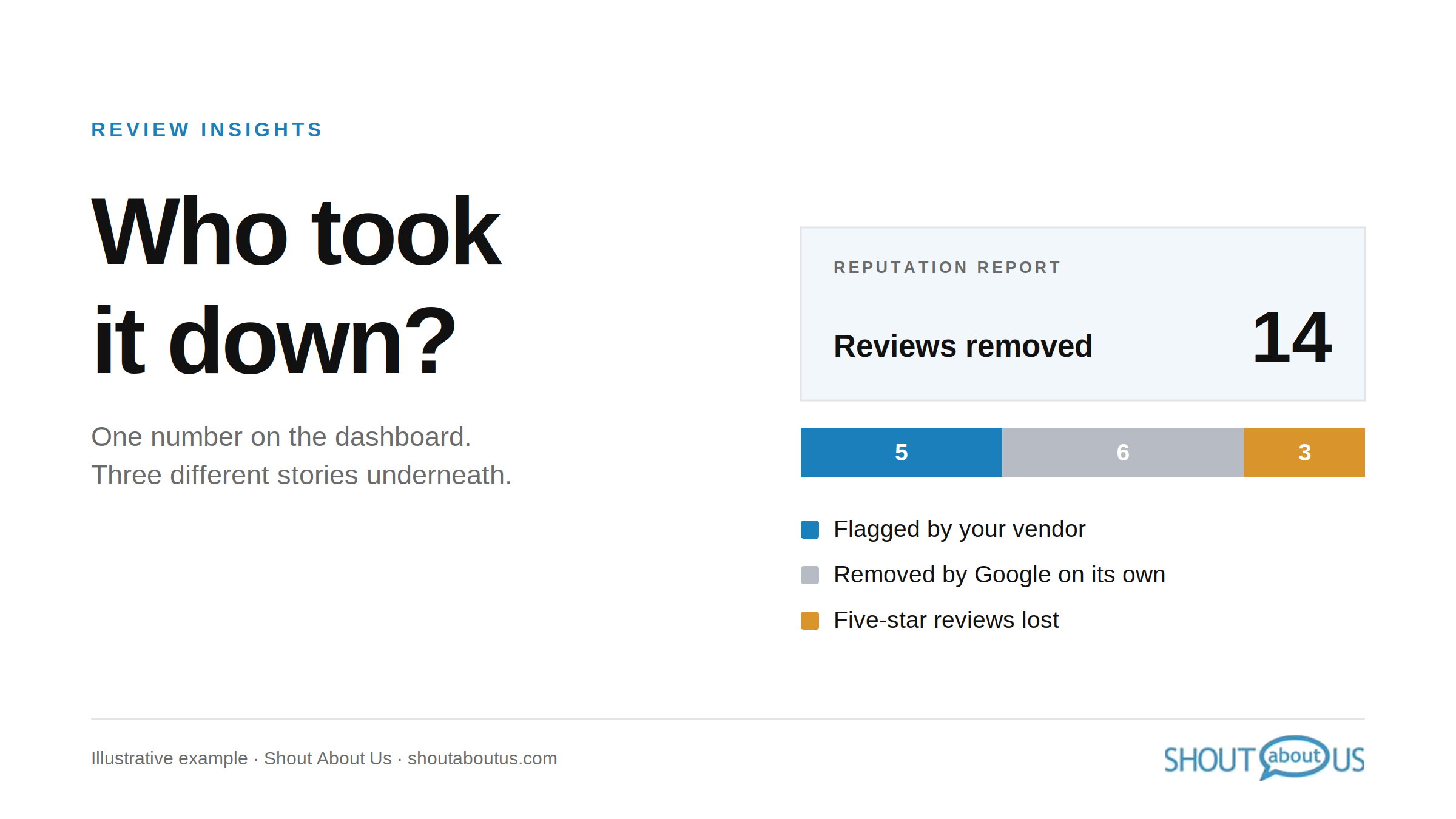
Who Actually Removed That Review?

Google removes reviews with or without a flag. If your reports count every disappearance as a win, you can't tell what your removal process did.

Cobi Emery

Add review management to your platform in days

Book a call to explore the API, see white-label demos, and get custom pricing.