Your reputation vendor might be taking credit for Google's work.
Google says it blocked or removed 292 million policy-violating reviews in 2025. Most of that happens automatically. Nobody flags anything. Google's filters just decide.
Now look at the "reviews removed" number in your reputation dashboard.
How many came down because someone flagged them? How many would have disappeared anyway?
Most reports can't tell you. A review was there yesterday. Today it's gone. It gets counted as a win.
Google's moderation runs continuously on every Business Profile. It catches fake engagement, incentivized reviews, conflict-of-interest reviews and content that breaks its policies. Google has said the majority of what it blocks never goes live at all. But a meaningful share is removed after it has already been posted, sometimes long after.
Timing is where reporting gets murky. In Localo's analysis of 335,520 deleted Google reviews, 65.3% of deleted reviews had stayed on the profile for more than 10 days, and 26% were more than a year old when they disappeared.
So when a flagged review comes down two weeks after the flag, that might be the flag working. It might also be Google's filters getting there on their own schedule.
A single "reviews removed" count can blend three very different outcomes:
The first is a result. The second is a coincidence. The third is a loss that rarely shows up in a report built around removals.
If your platform offers review flagging or removal to your customers, the reporting is part of the product. Customers judge whether the feature is worth paying for based on that number.
Overcounting feels good in the short term. But eventually a customer compares the dashboard to their own records, or notices that their rating dropped in the same month the report showed a string of wins. When that happens, the credibility of the whole feature takes the hit, not just the one number.
Accurate attribution also makes the feature easier to defend. A smaller number you can stand behind is worth more in a renewal conversation than a bigger one you can't explain.
If the answers are fuzzy, the removal number is too.
The question isn't how many reviews came down. It's who took them down, and what else went with them.
Shout About Us powers review data, response and flagging workflows for platforms through APIs. If you're scoping a removal feature or auditing the one you have, bring your sources and volume and we can walk through how reporting should work for your setup.

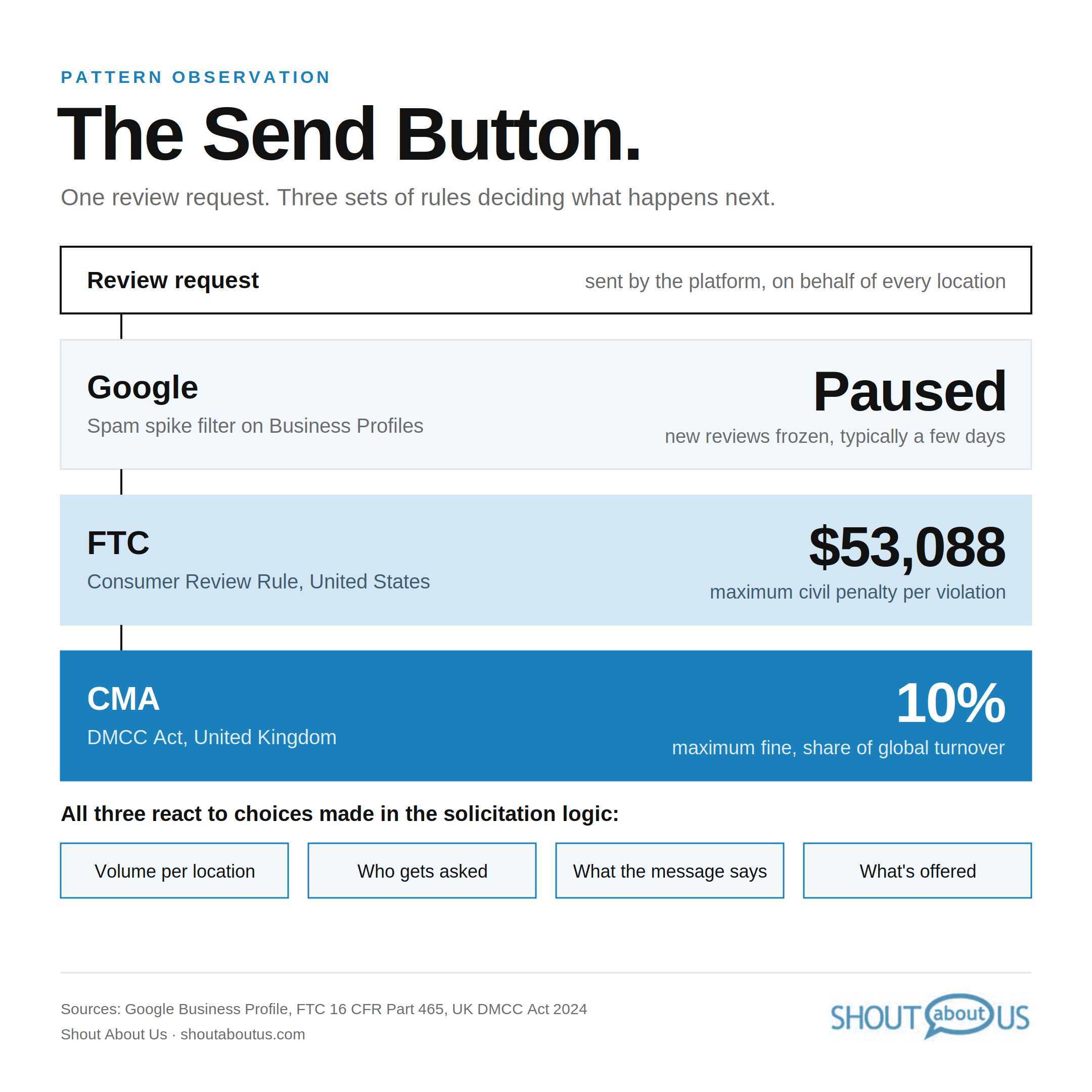
Google is pausing reviews when it detects spam spikes, and regulators in the US and UK have real penalties for prohibited review practices. For platforms sending requests at scale, every solicitation setting is a compliance decision.
API-first review infrastructure
for marketplaces & platforms