June 24, 2024
7-minute read

What Happens When You Report a Google Review? (3 Ways to Battle Bad Reviews)

When you report a Google review, Google checks it against its content policies. If the review breaks a policy, Google removes it. If not, the review stays up, the report is marked "Report reviewed - no policy violation" in Google's Reviews Management Tool, and you can file one appeal.

Reporting only works for reviews that break the rules. For honest negative reviews, the other two tools are a good public reply and fixing the problem behind the complaint. This guide covers all three, plus what changes when you handle review removal for many locations.

The 3 ways to handle bad Google reviews

  1. Report reviews that break Google's policies.
  2. Respond to every genuine review, especially the negative ones.
  3. Fix the cause so the same complaint stops coming back.

Which Google reviews can you report?

Google will not remove a review because it is negative, harsh or unfair in your view. It removes reviews that break its user contributed content policy. The main categories are:

  • Fake engagement. Paid or incentivized reviews, reviews posted from several accounts by one person, and reviews posted to hurt a competitor.
  • Conflict of interest. Reviews by the owner, current or former employees, or competitors.
  • Off-topic content. Reviews that aren't about a real experience at that business, such as rants about politics or the wrong company.
  • Restricted or offensive content. Hate speech, harassment, threats, obscenity and sexually explicit content.
  • Personal information. Phone numbers, addresses or other private details about someone.
  • Spam. Gibberish, repeated content and links to unrelated sites.

Before you report, ask one question: which policy does this review break? If you can't name it, reporting won't help, and a reply is the better move.

How to report a Google review: 4 ways

Method 1: From Google Maps

  1. Find your business on Google Maps.
  2. Open the Reviews tab.
  3. Find the review, then click or tap the three dots next to it.
  4. Select Report review and choose the reason.
Google maps reviews
step 1
step 2
step 3

The review shown above is only an example of the menu. It does not break Google's policies.

Method 2: From Google Search

  1. Search for your business name and open its Business Profile.
  2. Open the Google reviews.
  3. Find the review, then select the three dots next to it.
  4. Select Report review.
Google Search example
Google reviews

Method 3: From your Business Profile

According to Google's help page on reporting reviews, a verified owner or manager can:

  1. Go to the Business Profile.
  2. Select Read reviews.
  3. Select the report icon next to the review.
  4. Choose a reason, such as spam or profanity.
  5. Select Send report.

Method 4: From the Reviews Management Tool

  1. Open Google's Reviews Management Tool.
  2. Confirm the email shown is the one linked to the Business Profile, or select Switch account.
  3. Select the business.
  4. Choose Report a new review for removal.
  5. Select Report next to the review, choose the reason, and select Submit.

What happens after you report a Google review?

Google reviews the report against its policies. Google says review evaluation typically takes several days. Check progress in the Reviews Management Tool under Check the status of a review I reported previously. You'll see one of three statuses:

  • Decision pending. The review is flagged but hasn't been evaluated yet.
  • Report reviewed - no policy violation. Google found no violation. The review stays up, and you can appeal once.
  • Escalated - check your email for updates. You've appealed, and Google will email the final decision.

If the review is removed, it simply disappears from the profile. If it stays and you disagree, you can appeal.

How to appeal a Google review decision

  1. Open the Reviews Management Tool and confirm the right account.
  2. Select the business, then Check the status of a review I reported previously and appeals options.
  3. Select Appeal eligible reviews and choose the reviews. You can include up to 10 in one appeal.
  4. Select Continue, then Submit an appeal, and complete the form.
  5. Watch for an email with the verdict.

Each review gets one appeal, and the appeal decision is final. Make it count: name the specific policy, explain why the review breaks it, and add any facts Google can check, such as "no record of this customer" or "the reviewer is a former employee."

Special cases: fake, mistaken and duplicate reviews

Fake reviews

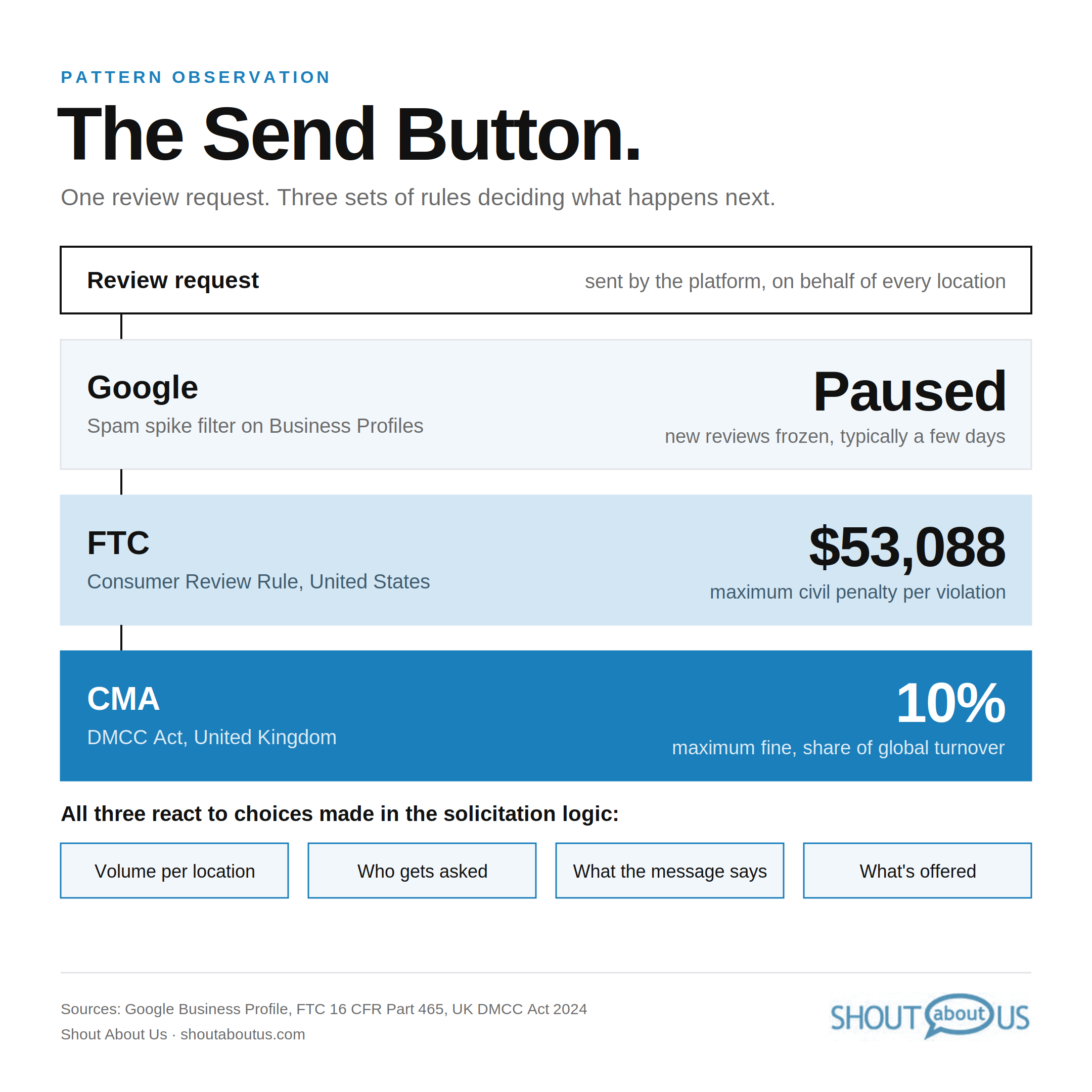
Signs that a review may be fake include a brand-new or empty reviewer account, a burst of similar reviews in a short time, the same reviewer hitting several of your locations, and vague complaints that match no real visit. Report these under fake engagement or conflict of interest. Google has also said, in its April 2026 Maps safety update, that when it sees a sudden spike in spam reviews on a profile it removes the fake content, pauses new reviews and alerts the owner.

Still reply to a fake negative review, briefly and calmly. Your audience is the next customer, not the reviewer. Say you have no record of the visit and invite the person to contact you directly.

Reviews meant for another business

Sometimes a real customer reviews the wrong business, especially when names are similar or a franchise has nearby locations. Clues include staff names you don't recognize or a service you don't offer. These reviews may qualify as off-topic, but a friendly reply often works too: thank them, explain politely that you can't find their visit and may not be the business they meant, and offer to help.

Duplicate reviews

The same text posted several times, or from several accounts, is spam and can be reported. Reply to each genuine review individually rather than pasting one answer everywhere. Identical replies look automated to everyone reading them.

What not to do

Never pressure a reviewer to delete or change a review, and never threaten legal action over an honest review. In the US, the FTC's rule on consumer reviews, in effect since October 21, 2024, prohibits suppressing reviews through intimidation, unfounded legal threats or false accusations. If you believe a review is defamatory, talk to a lawyer instead of arguing in public.

How to respond to negative Google reviews

  • Reply quickly. A fast, calm reply shows every reader that someone is listening.
  • Use the reviewer's name when it reads naturally.
  • Thank them for the feedback, even when it stings.
  • Apologize for the experience without arguing about the details.
  • Take it offline. Give a phone number or email so the conversation can continue privately.
  • Make it specific. Mention what they actually said, such as the wrong order or the long wait. Vary your wording from reply to reply.

For examples, see our guides to responding to 1-star reviews and responding to reviews faster.

How to prevent bad reviews in the first place

Read reviews across Google and every other site that matters for your industry, and look for themes. Common reasons customers leave negative reviews include:

  • Slow service or long waits
  • Rude or unhelpful staff
  • No follow-up after a problem
  • Missing amenities, such as Wi-Fi or parking
  • Accessibility problems
  • Cleanliness, pests or safety issues
  • Problems with an app or website
  • Noise, especially in hotels and apartments
  • Pushy sales experiences
  • Late or missed appointments
  • Subscriptions or plans that are hard to cancel
  • Unexpected charges

When the same complaint shows up again and again, fix the process behind it. That improves future reviews more than any reply can.

For platforms: handling review removal for many locations

If your platform offers review flagging to franchise systems, multi-location brands or the businesses on your marketplace, reporting one review at a time in Google's interface doesn't scale. A few things matter:

  • Access. Owner reporting and the Reviews Management Tool need an account with access to each Business Profile. Plan how that access is granted and kept current.
  • A log of every report. Record the review, the policy cited, the date filed, the status, any appeal and the outcome.
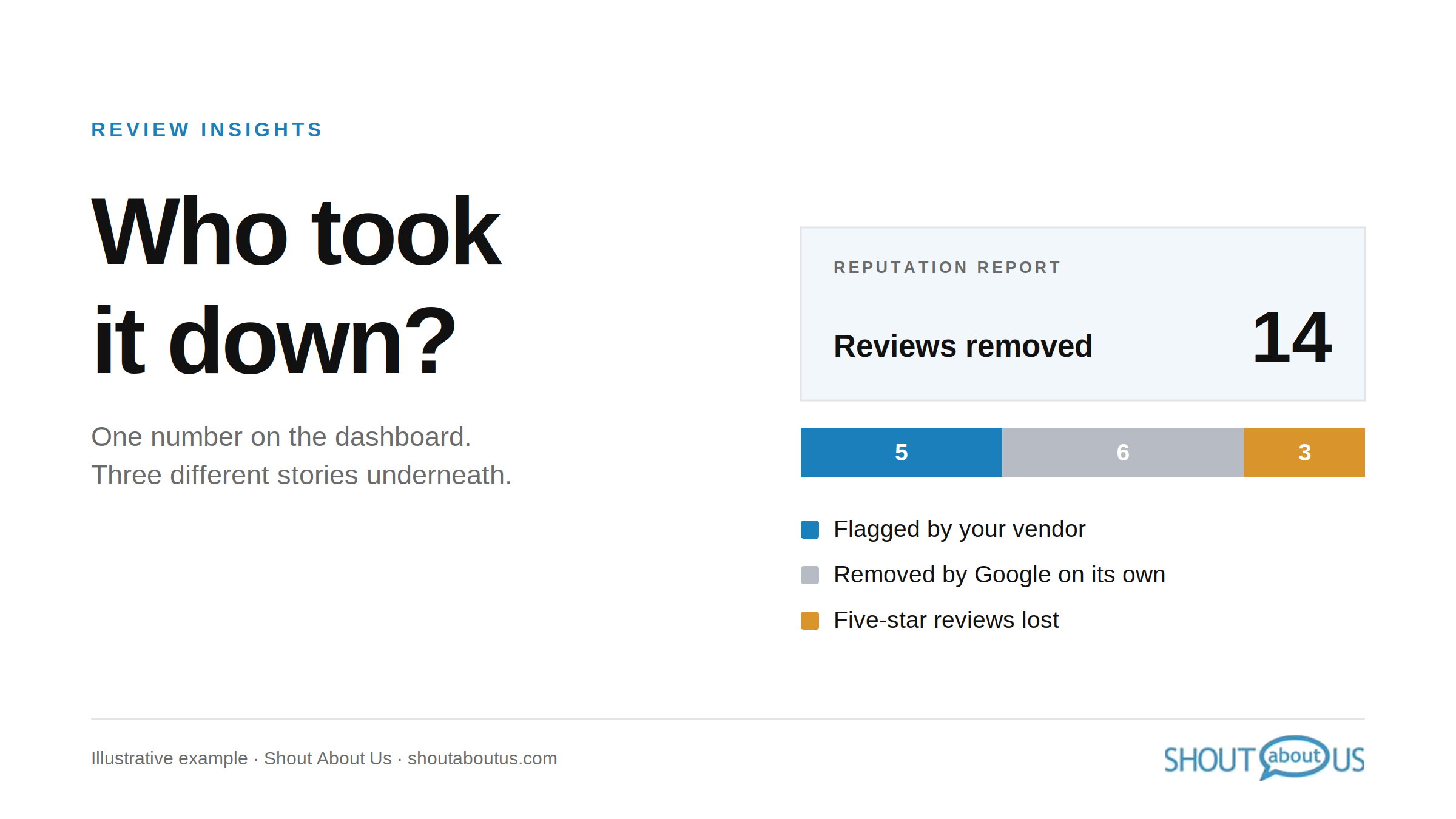
  • Honest attribution. Google also removes reviews on its own, including good ones. Tie each removal to a specific report, and track unflagged removals separately. Our post Who Actually Removed That Review? explains why this matters.
  • Consistent screening. Apply the same policy checks to every location so you report what qualifies and skip what doesn't.

Shout About Us is the review management API for marketplaces and platforms. The Review Removal API flags reviews that appear to break a site's policies and tracks each one through to a decision. It pairs with the Review Data API, which pulls reviews from Google, Yelp, Facebook and 80+ sites, and the Review Response API for replying to the reviews that stay up.

FAQ

How long does Google take to remove a reported review?

Google says evaluation typically takes several days, but there is no guaranteed deadline. Check the status in the Reviews Management Tool. If the report is still marked "Decision pending," Google hasn't evaluated it yet.

Can I get a Google review removed just because it is negative?

No. Google only removes reviews that break its policies. For honest negative reviews, reply publicly and fix the underlying issue.

How many times can I appeal a Google review decision?

Once per review. You can include up to 10 reviews in one appeal, and the decision on the appeal is final.

What if a competitor is posting fake reviews about my business?

Report each review under fake engagement or conflict of interest, and note any pattern, such as timing or similar wording. Google's policy specifically prohibits posting content to undermine a competitor's reputation.

Can an agency or platform report reviews for its customers' locations?

Yes, if it has owner or manager access to those Business Profiles. Keep a log of every report so you can show customers what was filed and what Google decided.

Handle review removal across every location

If your platform needs to flag policy-violating reviews and report on the results honestly, see the Review Removal API or book a demo.

SHARE THIS ARTICLE:

Frequently asked questions

No items found.
All
Best Practices
How much does a review management API cost? Pricing guide from Shout About Us
October 13, 2026
7-minute read
How Much Does a Review Management API Cost?

Pricing models, cost drivers and build-vs-buy for platforms, plus Shout About Us pricing: $0.50 to $3.00 per location per month plus usage.

Emily Homrok
All
Best Practices
October 5, 2026
5-minute read
Who Actually Removed That Review?

Google removes reviews with or without a flag. If your reports count every disappearance as a win, you can't tell what your removal process did.

Cobi Emery
All
Best Practices
September 28, 2026
7-minute read
If You Send Review Requests, You Need to Know the Rules

Google pauses reviews on spam spikes, and US and UK regulators penalize bad review practices. What platforms sending review requests need to know.

Cobi Emery

Add review management to your platform in days

Book a call to explore the API, see white-label demos, and get custom pricing.