To choose a white-label review management vendor or review management API, start by deciding what you'll build yourself and what you'll buy. Then compare vendors on five things: which review sites they cover and what you can do on each, how pricing scales with your locations, how they keep review requests compliant, how much of the experience carries your brand, and who handles problems after launch. A short list of direct questions, covered below, will separate the vendors who can support a platform from those built for a single business.
This guide is for product and engineering leaders at SaaS platforms, marketplaces, franchisors, white-label resellers and agencies who want to offer review management to many business locations under their own name.

White-label review management means offering review features to your customers under your brand, while a vendor provides the technology behind them. Your customers see your product, your logo and your support team. The vendor handles the connections to review sites, the data, and often the AI and messaging.
There are two common models:
Many platforms start with the parts they need most, such as review data, and add responding and solicitation later. A good vendor lets you buy one capability without the whole bundle.
Your customers already care about reviews. BrightLocal's 2026 Local Consumer Review Survey found that 97% of consumers read reviews for local businesses, the average consumer uses six review sites, and 80% are likely to use a business that responds to all of its reviews. 89% expect owners to respond.
For a platform, that creates a clear opportunity. If your customers manage reviews in a separate tool, you're missing a daily-use feature and a reason for them to stay. If they manage reviews inside your product, you own that workflow.
Building review management in-house can make sense when you only need one or two sources, the workflow is central to what makes your product different, and you have a team ready to maintain it for years.
Buying makes more sense when you need broad coverage across many sites, or when maintaining dozens of integrations would compete with your core roadmap. The ongoing work is the part teams underestimate:
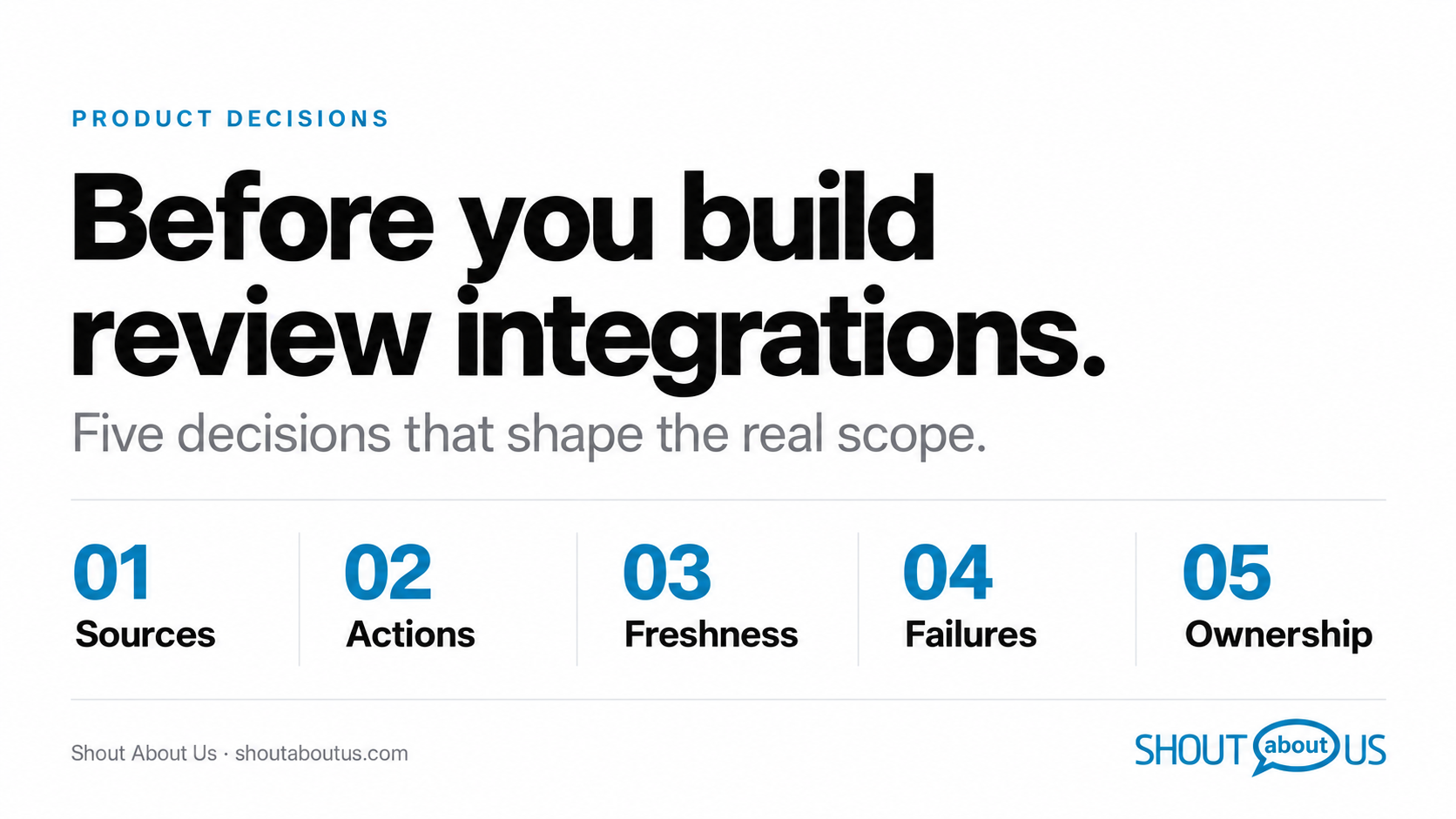
Buying does not remove your responsibility for the customer experience. You still own permissions, how status is shown in your product and how you talk to customers when something goes wrong. Our post on five decisions to make before you build review integrations is a useful worksheet whichever way you go.
Start with the sites your customers actually use. Google, Facebook and Yelp are the baseline, but a dental platform needs Healthgrades and Zocdoc, a hotel platform needs Tripadvisor and Booking.com, and an auto platform needs DealerRater and Cars.com. Our list of 36 review platforms by industry is a good starting checklist.
Then ask what "supported" means for each site. Pulling reviews, posting replies, sending review requests and flagging reviews for removal are separate capabilities. A vendor might read reviews from 80 sites but only post replies to a few. Get the answer per site, in writing.
Ask how often reviews are refreshed, whether edits and deletions are picked up, and how reviews are matched to locations. Ask for a sample of the data in the format you'll receive. A consistent, normalized format across sites saves your engineers a lot of mapping work.
Vendors price in different ways: per location per month, per seat, per API call or by usage, flat platform fees, or a mix. For a platform, the questions that matter are:
Model your cost at today's location count and at three times that. A price that works for 200 locations can break your margins at 5,000.
This is where vendors differ most, and where mistakes are most expensive. In the SEO world there's a split between "white hat" methods that follow the rules and "black hat" methods that try to game them. The same split exists in review management. Fake reviews, buying reviews and gating requests so only happy customers are asked can bring penalties from review sites and regulators.
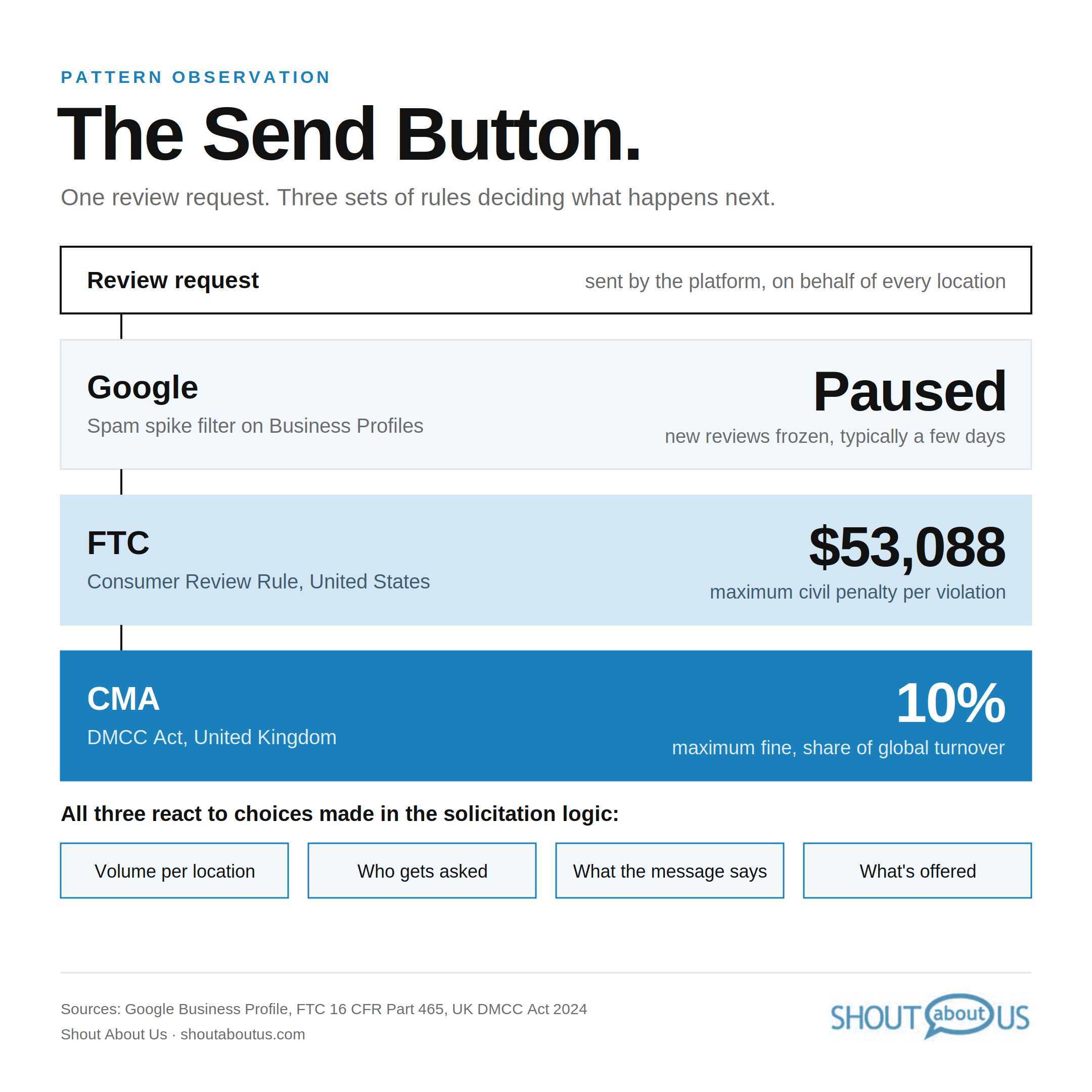
The rules now come from several directions: the review sites' own policies, the FTC's Consumer Review Rule in the US and the Digital Markets, Competition and Consumers Act 2024 (DMCC Act) in the UK. When your product sends review requests for thousands of businesses, every template and setting is a compliance decision. Our guide to review solicitation rules for platforms covers what to check.
Also ask about data handling: where review and customer contact data is stored, whether a data processing agreement is available, and what happens to your data if you leave.
For a true white-label offering, nothing your customer sees should carry the vendor's name. Check emails, SMS messages, review request landing pages, AI-drafted replies and any hosted pages. With an API, you control the interface entirely, but check what reaches end customers directly, such as request messages.
The features that matter for one business are not the same as the ones that matter for a platform with thousands of locations. Look for:
Ask who handles incidents, how quickly, and how issues on a specific review site are communicated. Ask what documentation exists, whether there's a sandbox, and how changes to the API are announced. Agree on exit terms before you sign: how you get your data out and how long it takes.
A vendor that answers these clearly, per site and in writing, is one you can build on.
Shout About Us is the review management API for marketplaces and platforms. You build the experience in your product under your brand, and choose the APIs you need:
Pricing is $0.50 to $3.00 per location per month, depending on volume, plus usage for the APIs you turn on. Single-API setups, such as review data only, start at the low end. See pricing for details.
It's review management technology that you resell or embed under your own brand. Your customers see your product; the vendor supplies the review site connections, data and tools behind it. It comes either as a branded dashboard or as an API you build into your own product.
Build if you need one or two sources and have a team to maintain them long term. Buy if you need broad coverage across many review sites, or if ongoing integration work would slow down your core roadmap.
Commonly per location per month, sometimes with usage charges for actions like review requests or AI replies. Compare vendors at your current and future location counts, and check for minimums and contract terms.
The main risks are in review requests: offering incentives, only asking happy customers and suggesting what to write. Google's policies, the FTC's Consumer Review Rule and the UK DMCC Act all apply. Sending requests in sudden bursts can also look unnatural to review sites. Read our guide to review solicitation rules.
With Shout About Us, yes. You can use a single API, such as review data only or response posting only, and single-API setups start around $0.50 per location per month plus usage.
Comparing review management vendors? Book a demo to walk through coverage, pricing and white-label options for your platform, or request an API key to test the API yourself.

The review management API
for marketplaces & platforms